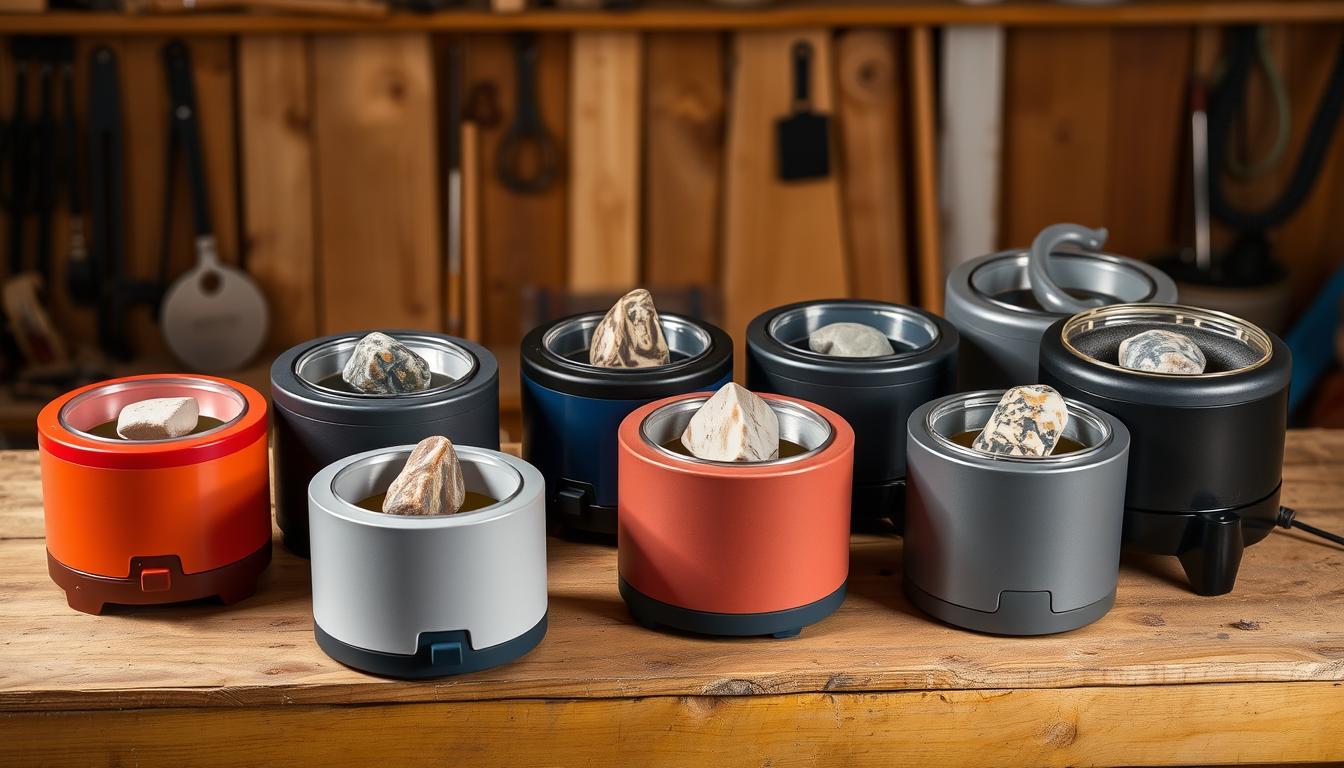
Affordable rock tumblers offer hobbyists and beginners an excellent entry point into the rewarding world of rock polishing. These budget-friendly machines transform rough stones into beautiful, polished gems without breaking the bank.
The rock tumbling process involves multiple stages, progressing from coarse grinding to fine polishing. Quality rotary tumblers under $150 make this fascinating hobby accessible to everyone, delivering professional results at a fraction of the cost of premium models.
TL;DR
- Quality rotary rock tumblers under $150 can handle 3-pound loads effectively for most hobbyist needs.
- The complete tumbling process takes 4-6 weeks using four grit stages from coarse (80 grit) to polish (14,000 grit).
- National Geographic and Lortone models offer the best reliability in the budget category with 1-year warranties.
- Proper rock selection requires choosing stones with Mohs hardness of 7 or higher to prevent breakage during tumbling.
Best Rotary Rock Tumblers Under $150
Finding quality equipment within budget constraints doesn’t mean compromising on results. Several manufacturers produce reliable rotary tumblers that deliver excellent performance for under $150.
These machines handle everything from rough beach stones to semi-precious minerals with consistent results.
National Geographic Hobby Rock Tumbler Kit
This complete starter kit includes everything needed for immediate rock tumbling success. The 1-pound barrel capacity works perfectly for beginners learning the four-stage process.
The kit comes with all four grit stages, polishing compound, and a detailed instruction guide. The compact design fits comfortably on most workbenches without taking up excessive space.
- Barrel capacity – 1 pound of rocks per cycle
- Complete kit – includes all grits and polish
- Quiet operation – runs at acceptable noise levels for home use
- Educational materials – detailed guide and rock identification chart
Lortone 3A Single Barrel Tumbler
Built for durability and consistent performance, the Lortone 3A represents excellent value in the budget category. This American-made tumbler features a robust motor designed for continuous operation.
The 3-pound barrel capacity allows for larger batches while maintaining proper tumbling action. Quality construction ensures years of reliable service with minimal maintenance requirements.
- Heavy-duty motor – designed for 24/7 operation
- Rubber barrel – reduces noise and prevents cracking
- American manufacturing – quality construction and parts availability
- Simple controls – single switch operation
Chicago Electric 3lb Rock Tumbler
Harbor Freight’s Chicago Electric model offers impressive capacity at an unbeatable price point. The 3-pound barrel handles substantial rock loads while maintaining proper tumbling ratios.
Despite the budget price, this tumbler delivers consistent results when properly maintained. The larger capacity makes it ideal for processing multiple rock types simultaneously.
- Large capacity – 3 pounds per tumbling cycle
- Affordable pricing – exceptional value for money
- Sturdy construction – handles heavy loads effectively
- Wide availability – sold at Harbor Freight locations nationwide
Understanding Rotary Tumbler Operation
Rotary tumblers work by continuously rotating a sealed barrel containing rocks, grit, and water. The constant motion creates friction between rocks and abrasive materials, gradually wearing away rough surfaces.
This process mimics natural weathering but occurs much faster through controlled mechanical action. The four-stage progression uses increasingly fine abrasives to achieve mirror-like finishes.
The Four-Stage Process
Professional results require following the complete four-stage sequence without shortcuts. Each stage serves a specific purpose in the transformation from rough stone to polished gem.
Rushing through stages or skipping steps invariably leads to poor final results and wasted time. Understanding how long to tumble rocks is crucial for achieving optimal results.
- Coarse grinding (80 grit). Removes sharp edges and major surface irregularities over 7-10 days.
- Medium grinding (220 grit). Smooths surfaces and eliminates scratches from coarse stage over 7-10 days.
- Fine grinding (400 grit). Prepares surface for polishing by creating uniform smoothness over 7-10 days.
- Polishing (14,000 grit). Creates final mirror finish using aluminum oxide or cerium oxide over 5-7 days.
Essential Features to Consider
Barrel capacity determines how many rocks you can process per cycle, but bigger isn’t always better. Proper tumbling requires maintaining correct ratios between rocks, grit, and water regardless of barrel size.
Motor quality directly affects longevity and consistent operation throughout multi-week cycles.
Barrel Material and Design
High-quality barrels use thick rubber or specialized plastics that resist cracking under constant stress. The interior surface should remain smooth to prevent snagging during rotation.
Proper seal design prevents leakage while allowing easy access for cleaning between stages.
- Rubber construction – provides durability and noise reduction
- Leak-proof seals – prevents water damage and mess
- Easy cleaning – smooth interior surfaces for thorough washing
- Proper volume – maintains correct tumbling ratios
Money-Saving Tip
Buy grit in bulk quantities rather than small packages to reduce per-pound costs significantly. A 5-pound container of each grit stage costs less than multiple small packages and provides enough material for dozens of tumbling cycles.
Rock Selection for Best Results
Successful tumbling starts with choosing appropriate rocks based on hardness and structure. The Mohs hardness scale helps identify suitable candidates for the tumbling process.
Mixing rocks of similar hardness prevents softer stones from wearing away before harder ones reach completion. Evaluating rocks before tumbling ensures better results and prevents wasted time.
Ideal Rock Types
Quartz varieties like agate, jasper, and carnelian tumble beautifully and provide excellent learning opportunities. These materials have consistent hardness and produce stunning results with proper technique.
Avoid sedimentary rocks, soft minerals, and specimens with visible cracks that might break apart during tumbling.
- Agate – consistent hardness and beautiful patterns
- Jasper – durable and available in many colors
- Carnelian – translucent orange to red varieties
- Petrified wood – fascinating patterns and good hardness
- Tiger’s eye – chatoyant effect creates visual interest
Maintenance and Troubleshooting
Regular cleaning between stages prevents contamination that ruins final results. Thoroughly wash barrels, lids, and rocks before progressing to finer grit stages.
Monitor motor temperature during extended operation and provide adequate ventilation to prevent overheating.
Common Issues and Solutions
Excessive noise often indicates worn belts, loose components, or improper loading ratios. Check all mechanical connections and ensure proper rock-to-water ratios.
Poor polish results usually stem from inadequate cleaning between stages or using worn-out grit materials.
- Uneven wear patterns – adjust rock sizes or tumbling ratios
- Motor overheating – improve ventilation and reduce load
- Poor final polish – thoroughly clean between all stages
- Excessive noise – check belt tension and component alignment
Grit and Polish Selection
Quality abrasives make the difference between mediocre and exceptional results. Silicon carbide grit works best for the first three stages, while aluminum oxide or cerium oxide produces superior polish.
Pre-packaged grit sets ensure proper progression through all four stages with compatible materials.
Grit Stage Breakdown
Each grit stage requires specific amounts and timing for optimal results. Following manufacturer recommendations prevents waste and ensures consistent outcomes.
Water quality affects tumbling results, with soft water generally producing better outcomes than hard water with high mineral content.
| Stage | Grit Size | Duration | Purpose |
|---|---|---|---|
| 1 | 80 grit | 7-10 days | Coarse shaping |
| 2 | 220 grit | 7-10 days | Medium smoothing |
| 3 | 400 grit | 7-10 days | Fine preparation |
| 4 | Polish | 5-7 days | Final finish |
Articles You May Like
Frequently Asked Questions
What barrel capacity works best for beginners?
A 3-pound capacity provides the ideal balance between processing volume and manageable batch sizes for new tumblers.
How long does each tumbling stage take?
Most stages require 7-10 days of continuous operation, with the final polish stage taking 5-7 days for optimal results.
Can I tumble different rock types together?
Only tumble rocks of similar hardness together to ensure even wear and prevent softer stones from being destroyed.
What causes excessive noise during operation?
Loose components, worn belts, or improper loading ratios typically cause excessive noise during tumbling cycles.
How do I know when to progress to the next stage?
Rocks should show uniform wear patterns and smooth surfaces before advancing to the next finer grit stage.
Final Thoughts
Affordable Rock Tumblers Under $150 provide an excellent entry point into this rewarding hobby without requiring major financial investment. Quality models from established manufacturers deliver professional results when operated correctly.
Start with a reliable unit like the National Geographic or Lortone models and gradually expand your equipment as skills develop. Once you’ve mastered the basics, you can explore proper rock preparation techniques and begin creating beautiful displays for your polished stones.