
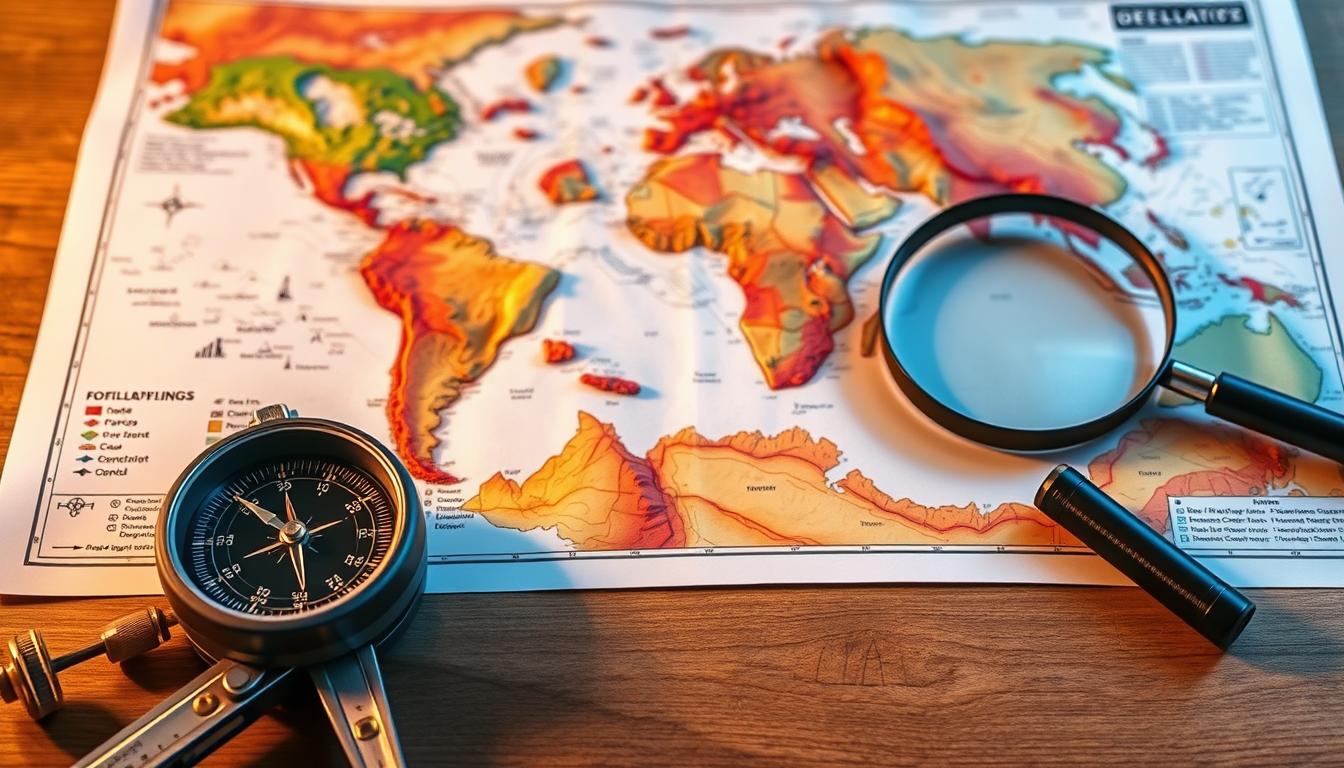
A Geology Map is a detailed visual guide that displays the distribution of rock types, formations, and geological structures across Earth’s surface. These specialized maps use colors, patterns, and symbols to represent different materials found at or near ground level, making complex geological information accessible to both professionals and outdoor enthusiasts.
Understanding how to read these maps opens up new possibilities for exploration and discovery. Whether you’re planning a hiking adventure, conducting environmental research, or simply curious about the ground beneath your feet, geology maps provide valuable insights that can enhance your outdoor experiences and safety.
TL;DR
- Geology maps use distinct colors to represent different rock types – typically igneous rocks appear in reds and purples, sedimentary rocks in yellows and browns, and metamorphic rocks in greens and grays.
- Map scales commonly range from 1:24,000 for detailed local surveys to 1:250,000 for regional overviews, with each scale serving different practical purposes.
- Strike and dip symbols show rock layer orientations using a line with numbers – the line shows direction and numbers indicate the angle of tilt.
- Digital geology map apps like Rockd and GeoMapApp provide GPS-enabled field access to geological data without requiring paper maps.
Geology Map Fundamentals
A geology map serves as a window into Earth’s history and composition. These maps translate complex three-dimensional geological relationships into a readable two-dimensional format that anyone can learn to interpret with practice.
The foundation of every geology map lies in its systematic approach to categorizing and displaying geological information. Map makers group similar rock types and formations into distinct units, each assigned specific colors and patterns that remain consistent across the map.
Core Map Components
Every effective geology map contains several essential elements that work together to tell the geological story of an area. The legend serves as your primary reference guide, explaining what each color, pattern, and symbol represents on the map surface.
- Legend and Key – Explains all symbols, colors, and patterns used throughout the map
- Scale Bar – Shows the relationship between map distances and real-world measurements
- North Arrow – Indicates magnetic or true north direction for proper orientation
- Coordinate System – Provides precise location references using latitude/longitude or grid systems
- Rock Unit Descriptions – Brief explanations of geological formations and their characteristics
Reading Geological Symbols and Patterns
Geological symbols form a standardized language that transcends regional differences in mapping styles. Learning these symbols allows you to read any geology map regardless of where it was created or by whom.
The most common symbols indicate structural features like faults, folds, and rock layer orientations. Strike and dip symbols appear as lines with accompanying numbers – the line shows the direction of rock layers while the number indicates how steeply they tilt.
Color Coding Systems
Colors on geology maps follow established conventions that help identify rock types at a glance. Igneous rocks typically appear in warm colors like reds, oranges, and purples, reflecting their fiery volcanic origins.
Sedimentary rocks usually display in earth tones such as browns, tans, and yellows, representing their formation from accumulated sediments. Metamorphic rocks often show in cooler colors like greens, blues, and grays, indicating their transformation under pressure and heat.
Pattern Recognition
Patterns overlay colors to provide additional information about rock characteristics and geological processes. Dotted patterns might indicate loose sediments, while lined patterns could represent layered rock formations.
- Solid Colors – Represent uniform rock types or formations
- Dotted Patterns – Often indicate unconsolidated materials like sand or gravel
- Lined Patterns – Show layered or stratified rock formations
- Cross-hatched Areas – May represent complex mixed formations
Map Scale and Practical Applications
Understanding map scale determines how much detail you can extract from a geology map and influences which maps work best for specific purposes. Large-scale maps (1:24,000) show fine details perfect for hiking and local exploration, while small-scale maps (1:250,000) cover broader regions ideal for understanding regional geological patterns.
Scale affects everything from the visibility of small geological features to the accuracy of distance measurements. A 1:50,000 scale map means one unit on the map equals 50,000 of the same units in the real world.
Quick Scale Reference
Remember that larger scale numbers actually show smaller areas with more detail, while smaller scale numbers cover larger areas with less detail. A 1:24,000 map shows more detail than a 1:100,000 map.
Field Navigation Techniques
Successful geology map navigation combines traditional orienteering skills with geological knowledge. For comprehensive guidance on this topic, check out our detailed resource on rockhounding map reading which covers navigation techniques specifically for mineral collectors.
Use a compass to align your map with magnetic north, then adjust for local magnetic declination if working with true north coordinates. This ensures accurate navigation and helps you correlate map features with actual terrain.
Rock Type Identification
Identifying rock types on geology maps requires understanding both the map’s color scheme and basic geological principles. Each map includes detailed descriptions of local rock units, typically found in accompanying text or expanded legends.
Focus on major rock categories first before diving into specific formations. Igneous rocks form from cooling magma or lava, sedimentary rocks develop from compressed sediments, and metamorphic rocks result from existing rocks transformed by heat and pressure.
Formation Characteristics
Rock formations represent distinct geological units with consistent characteristics across their extent. These formations receive formal names based on type locations where they were first studied and described.
- Age Relationships – Older rocks typically lie beneath younger ones unless disturbed by geological processes
- Contact Types – Sharp boundaries indicate rapid changes, while gradual transitions suggest slower processes
- Thickness Variations – Formation thickness changes reveal information about ancient environments
- Lateral Extent – How far formations extend indicates the scale of past geological events
Structural Geology Features
Geological structures record Earth’s dynamic history through features like faults, folds, and joints. These structures influence everything from groundwater flow to slope stability, making them crucial for practical applications.
Faults appear as lines on geology maps, often with symbols indicating movement direction and fault type. Normal faults show extension, reverse faults indicate compression, and strike-slip faults reveal lateral movement.
Fold Structures
Folds form when rock layers bend under stress rather than breaking. Anticlines arch upward like inverted bowls, while synclines sag downward like regular bowls.
Understanding fold patterns helps predict where different rock types might appear at the surface, even when the actual fold hinges lie underground. This knowledge proves valuable for resource exploration and hazard assessment.
Digital Geology Resources
Modern technology has transformed geology map access and usability through digital platforms and mobile applications. These tools provide real-time GPS integration, offline map storage, and interactive features that enhance field work efficiency.
Popular applications like Rockd, GeoMapApp, and various government geological survey apps offer comprehensive geological data sets accessible from smartphones and tablets. These platforms often include additional features like rock identification guides and geological educational content.
Online Map Sources
Government geological surveys provide extensive online map collections, often free to download and use. Learning how to research rockhounding sites using these online resources can significantly enhance your field work success. The USGS offers comprehensive coverage for the United States, while similar organizations serve other countries worldwide.
- USGS Geology Maps – Comprehensive US geological mapping with multiple scale options
- State Geological Surveys – Detailed regional mapping with local geological expertise
- Academic Institutions – Specialized maps and research-focused geological data
- Commercial Providers – Enhanced maps with additional features for professional use
Articles You May Like
Frequently Asked Questions
What do the different colors mean on a geology map?
Colors represent different rock types and formations, with igneous rocks typically shown in reds and purples, sedimentary rocks in browns and yellows, and metamorphic rocks in greens and grays. Each map includes a legend explaining its specific color scheme.
How do I determine the age of rocks shown on a geology map?
Rock ages appear in the map legend or accompanying descriptions, usually expressed in geological time periods like Cretaceous or Ordovician. Relative ages follow the principle that deeper layers are generally older unless disrupted by geological processes.
Can I use geology maps for hiking safely?
Yes, geology maps help identify potential hazards like unstable slopes, areas prone to rockfall, and regions with loose sediments. They also reveal interesting geological features that enhance hiking experiences when combined with topographic information.
What scale geology map should I use for different purposes?
Use 1:24,000 scale maps for detailed local exploration and hiking, 1:50,000 to 1:100,000 for regional planning and broader area assessment, and 1:250,000 or smaller scales for understanding regional geological patterns and large-scale planning.
How accurate are digital geology map apps compared to paper maps?
Digital apps use the same data as paper maps but offer GPS integration and real-time location tracking for improved accuracy in the field. However, battery dependence and screen visibility in bright sunlight can be limitations compared to paper maps.
Final Thoughts
Geology Map reading skills open doors to deeper understanding of the natural world around us. Whether you’re exploring new hiking trails, assessing property for development, or simply satisfying curiosity about local geological history, these maps provide reliable scientific information in an accessible format.
Start practicing with a local geology map and spend time in the field correlating map features with actual rock outcrops and landforms. Remember to pack all the essential items from our complete rockhounding checklist and follow proper rockhounding safety tips when exploring new geological areas. This hands-on approach builds confidence and develops the visual recognition skills that make geology maps truly valuable tools.