The Mohs Hardness Scale Explained is a simple ranking system that helps identify minerals and gemstones based on how easily they can be scratched. Created by German geologist Friedrich Mohs in 1812, this scale remains the standard method for testing mineral hardness today.
Understanding this scale can help you identify unknown stones, determine their value, and learn proper care techniques. Whether you’re a rock hound, jewelry collector, or just curious about the stones in your collection, knowing how hardness testing works opens up a world of mineral identification possibilities. This knowledge is especially crucial for understanding rock hardness and polish relationships when working with stones.
TL;DR
- The Mohs scale ranks minerals from 1 (softest) to 10 (hardest) based on scratch resistance.
- Diamond rates 10 on the scale, while talc rates 1 as the softest mineral.
- You can test hardness at home using common items like coins, glass, and steel files.
- Minerals with hardness 7 or higher are considered durable enough for everyday jewelry wear.
Mohs Hardness Scale Explained
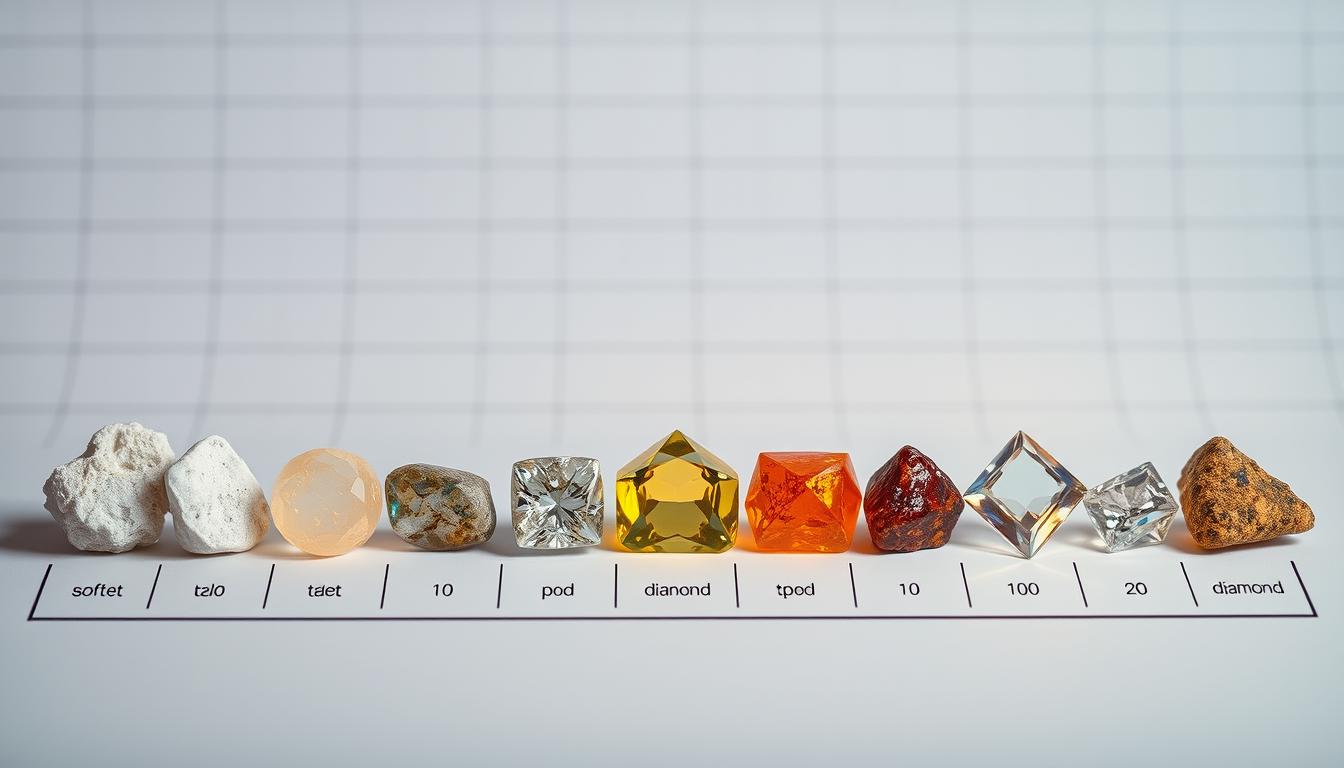
The Mohs scale uses ten reference minerals to create a hardness ranking system. Each mineral can scratch all minerals below it on the scale but cannot scratch those above it.
This simple test method requires no special equipment – you just need to see which minerals can scratch others. The scale works because hardness is a fundamental physical property that remains consistent across all samples of the same mineral. For rock tumbling enthusiasts, this principle is essential when selecting the best rocks for perfect polish.
The Ten Reference Minerals
Here are the ten minerals that define each hardness level:
- Talc (1). Feels greasy and can be scratched with a fingernail.
- Gypsum (2). Can be scratched with a fingernail but feels harder than talc.
- Calcite (3). Scratches with a copper penny but not a fingernail.
- Fluorite (4). Easily scratched with a steel knife blade.
- Apatite (5). Can be scratched with a steel knife but requires pressure.
- Orthoclase Feldspar (6). Cannot be scratched with steel but scratches window glass.
- Quartz (7). Scratches steel and glass easily.
- Topaz (8). Harder than quartz and scratches it readily.
- Corundum (9). Includes ruby and sapphire – extremely hard stones.
- Diamond (10). The hardest natural material known.
How to Test Mineral Hardness at Home
You can determine a mineral’s approximate hardness using common household items. This method gives you a practical way to identify unknown specimens without needing the actual reference minerals.
Start with the softest test materials and work your way up until you find something that scratches your specimen. The hardness falls between the last item that couldn’t scratch it and the first item that could.
Common Test Materials
- Fingernail (2.5) – scratches talc and gypsum.
- Copper penny (3.5) – scratches calcite and softer minerals.
- Steel knife or nail (5.5) – scratches apatite and below.
- Window glass (5.5) – same hardness as steel knife.
- Steel file (6.5) – scratches orthoclase feldspar.
- Streak plate (7) – made of unglazed porcelain, scratches quartz.
Testing Safety Tip
Always scratch in an inconspicuous area of your specimen. Test on a fresh surface rather than a weathered or altered area for accurate results.
Practical Applications
Knowing mineral hardness helps in many practical situations. Jewelers use hardness to identify gemstones, while collectors use it to properly care for their specimens.
The scale also guides jewelry selection – stones with hardness 7 or higher resist scratching during daily wear. Softer stones work better as occasional-wear pieces or in protected settings. When tumbling stones, hardness compatibility is crucial, and knowing which rocks not to tumble can save you from disappointing results.
Jewelry Durability Guidelines
- Hardness 7-10 – excellent for rings and daily-wear jewelry.
- Hardness 5-6 – good for earrings and pendants with careful handling.
- Hardness 3-4 – best for collector pieces or very protected settings.
- Hardness 1-2 – display specimens only, too soft for jewelry.
Common Minerals and Their Hardness
Many minerals fall between the standard reference points on the Mohs scale. Understanding where common stones rank helps with identification and care decisions.
Most gemstones used in jewelry fall between hardness 6 and 9, making them durable enough for regular wear while still workable for cutting and setting. For tumbling purposes, stones like quartz can be tumbled successfully due to their hardness of 7, while jasper tumbling also works well at similar hardness levels.
Popular Gemstones by Hardness
- Hardness 6-6.5 – moonstone, labradorite, tanzanite.
- Hardness 7 – amethyst, citrine, rose quartz, jasper.
- Hardness 7.5-8 – emerald, aquamarine, tourmaline.
- Hardness 8-8.5 – spinel, chrysoberyl, topaz.
- Hardness 9 – ruby, sapphire, alexandrite.
Limitations of the Mohs Scale
While useful, the Mohs scale has some important limitations to understand. The intervals between numbers aren’t equal – the difference between 9 and 10 is much larger than between 1 and 2.
The scale also only measures scratch hardness, not toughness or resistance to breaking. Some hard minerals like diamond can still chip or cleave along crystal planes despite their high hardness rating. This is why understanding mixed hardness rock tumbling techniques is essential for successful results when working with various stone types together.
Articles You May Like
Frequently Asked Questions
Can two minerals with the same hardness scratch each other?
Minerals with identical hardness can sometimes scratch each other, but the scratches will be very faint and difficult to see.
Why do some minerals show different hardness in different directions?
Some minerals have different hardness along different crystal faces due to their internal atomic structure, though this variation is usually small.
Is the Mohs scale the only hardness scale used?
Scientists also use more precise scales like the Vickers and Knoop hardness tests, but Mohs remains standard for mineral identification.
Can synthetic materials be harder than diamond?
Yes, some synthetic materials like aggregated diamond nanorods can exceed diamond’s hardness, but they’re not included in the traditional Mohs scale.
Final Thoughts
The Mohs Hardness Scale Explained provides a simple but powerful tool for understanding and identifying minerals. This 200-year-old system continues to serve rock hounds, jewelers, and geologists worldwide because it works reliably with basic tools.
Start practicing hardness tests on known specimens to build your skills, then apply this knowledge to identify mystery stones in your collection.